
By The Sculpted Consultant
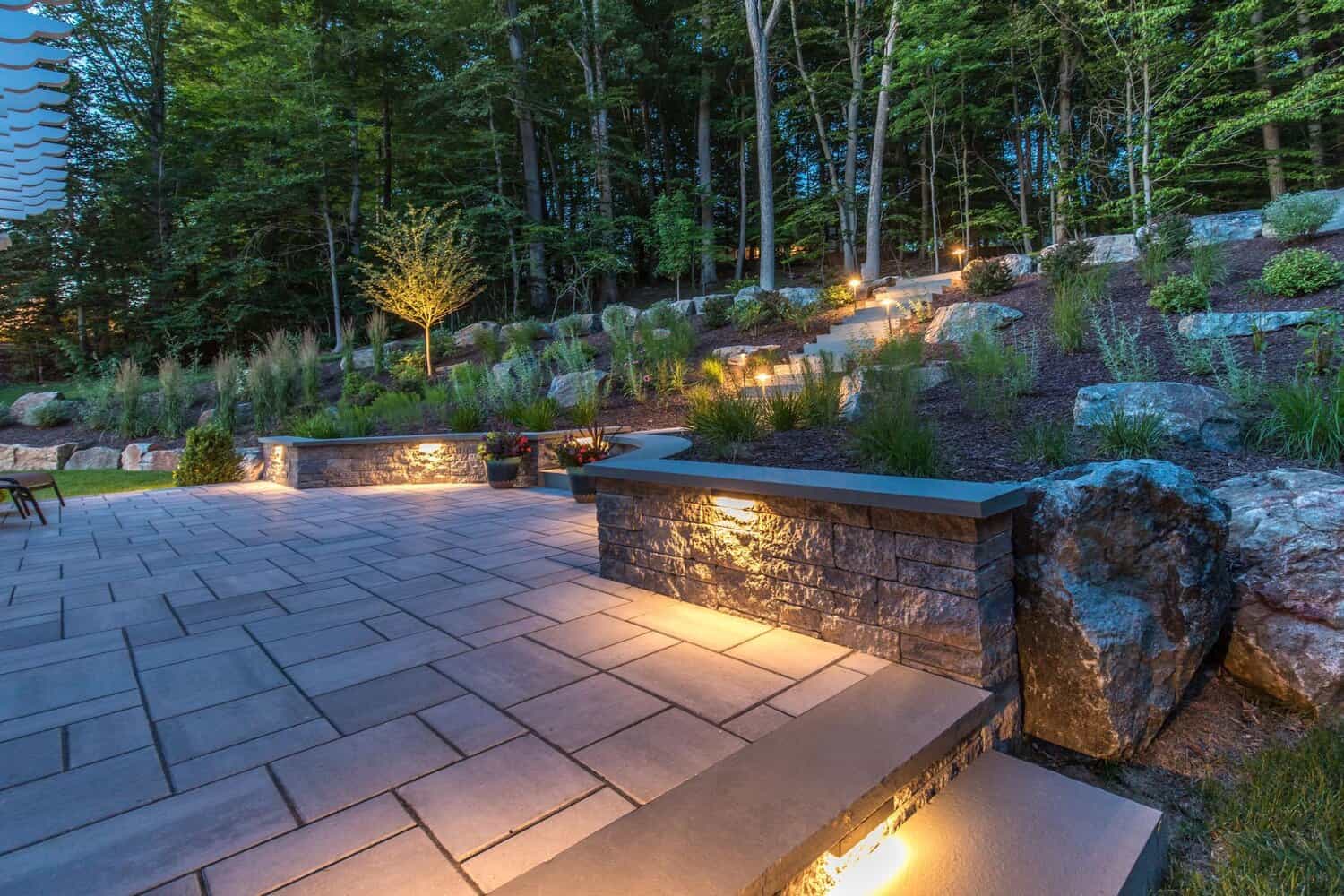
Acreage lighting is its own animal. There’s no neighbour’s porch light spilling over the fence, no streetlight at the corner, no ambient glow from a strip mall. You get to decide where the light is, and where the dark is. That’s a more interesting design problem than most people realize, and it’s also where we see the most expensive mistakes.
Here’s how we think about lighting an acreage in southern Alberta, what holds up to the climate, and what to leave alone.
What lighting is for
Three jobs, in our order of importance.
Navigation. Walking from the driveway to the front door, from the deck to the hot tub, from the back patio to the firepit. If people can’t see their feet, the lighting has failed.
Atmosphere. Lighting that makes the property feel inhabited and inviting after dark. This is mostly accent lighting on trees, water features, and architectural details.
Security. Important, but rarely the right reason to light up the whole property. Motion-activated lighting at entry points covers the security need without turning the acreage into a parking lot.
If you only ever invest in navigation lighting, the property will feel safe and usable at night. Atmosphere lighting on top of that is what makes it feel intentional.
The dark sky question
This part matters more on acreages than in the city. You probably moved out of town partly for the dark sky. If you light the property like a hotel parking lot, you’ve thrown that away.
The fixtures, the colour temperature, and the placement all matter:
Fixtures should be downward-facing, with shielded sources. No exposed bulbs blasting sideways. Most quality landscape fixtures are designed this way; cheap ones often aren’t.
Colour temperature should be warm. We use 2700K to 3000K for almost everything. Cool white (4000K and up) reads as institutional and washes out the warm tones in stone, wood, and planting.
Placement should be deliberate. Light what’s important. Leave the rest dark. Twelve carefully placed fixtures usually look better than 30 evenly spaced ones.
Pathway lighting that doesn’t suck
The “row of mushroom lights every 4 feet down the path” look is the default for cheap installations and it’s almost always wrong. Pathway lighting works when it’s spaced loosely (8 to 12 feet apart for fixtures, often more), kept low to the ground, and aimed to wash light across the path rather than punctuate it.
We sometimes use no path fixtures at all, and instead light the path indirectly from accent fixtures on adjacent shrubs or stones. The path is visible because the surroundings are lit, not because the path itself is.
Accent and uplighting
Trees are the easy win. A single uplight at the base of a mature tree, aimed up into the canopy, can transform the look of a property. Saskatoons, aspens, spruces, and bur oaks all photograph beautifully when lit this way.
Water features deserve their own lighting. A pond or waterfall in the dark is just a black hole. Lit subtly from the side or from underwater, it becomes a focal point.
Architectural lighting on the house itself — uplighting on stone, downlighting from soffits — is where many acreage builds get the biggest visual return per dollar.
The driveway problem
Long acreage driveways are where lighting decisions get expensive fast. The instinct is to line the whole driveway with bollards. Don’t. It looks like an airport runway.
Better: light the entry point clearly (where the driveway meets the road), light any turn or transition where someone could miss the road edge, and light the destination (the parking pad or garage). The middle of the drive can be left dark. Headlights handle it.
Common mistakes
Too many fixtures. The biggest one. More fixtures equals more glare, more competing light, more cost, more failure points.
Wrong colour temperature. Cool-white LEDs are everywhere now because they’re cheap. They read as harsh on a residential property.
No transformer headroom. Low-voltage systems run on a transformer sized to the load. If the system is loaded right to its limit, the fixtures dim, the runs voltage-drop, and adding anything later means upsizing the transformer. We oversize on day one.
Cheap fixtures. The fixture spec is what determines whether the system lasts 5 years or 20. Cheap aluminum fixtures pit and fail in our climate. Brass and copper hold up.
Skipping the controller. A good lighting controller (timer, photocell, smart system) makes the system effortless. Without one, lights either run all night or someone forgets to turn them on.
LED and low-voltage
Almost everything we install now is LED, low-voltage. The reasons: longer fixture life, much lower energy use, safer wiring (12V, sometimes 15V on longer runs to compensate for voltage drop), and easier to extend later. Outdoor fixtures should be rated IP65 or better; underwater pond lights need IP68.
Line-voltage systems still have a place — typically for very long runs or specific architectural applications — but for residential and acreage landscape lighting, low-voltage LED is the standard.
Wiring it now vs later
If you’re doing any kind of hardscape, planting, or pool work, run the conduit for lighting now. Even if the lighting design isn’t finalized. Pulling wire through pre-installed conduit is cheap; trenching across a finished patio to add a circuit later is not.
For new builds and major landscape projects, we’ll usually rough-in lighting infrastructure as a phase one even if the fixtures themselves come later in phase two or three.
What it costs to do well
Good landscape lighting is one of the highest visual-return investments on a property. The fixtures themselves are not the expensive part — design, wiring, transformer sizing, and quality of install are. A well-designed system on a Calgary-area acreage will use fewer fixtures than people expect, run on a single transformer, and look intentional from the day it’s commissioned.
If your acreage feels like a black hole the moment the sun sets, or like a runway the moment you turn the lights on, neither extreme is what we’d recommend. There’s a much better middle, and it’s mostly about restraint.
Leave a Reply